Class III face: concave, long, short or asymmetric
More than a large chin, it's the relationship between the upper and lower jaw, and with it, the whole face.
What a Class III face is like
In a Class III face, when you close your mouth the lower teeth sit in front of the upper ones, what's called an underbite, or they meet edge to edge. The lower jaw may have grown more than the upper jaw, the upper jaw may have lacked development, or a combination of both, in all three dimensions. Sometimes it runs in the family, though that isn't a rule.
The most common Class III faces are:
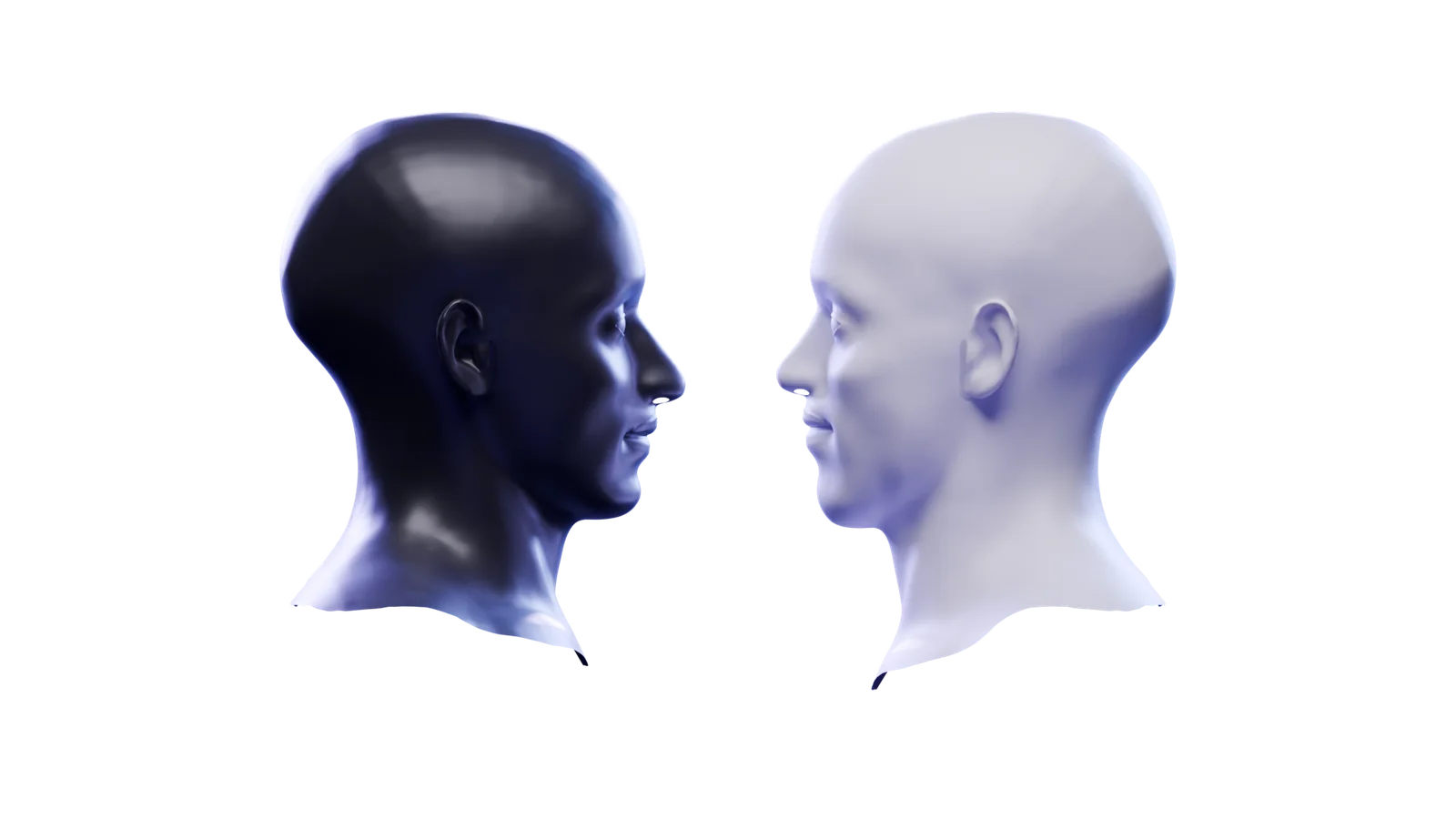
Concave: the middle of the face looks sunken: flat cheekbones, a drooping nasal tip and a lower jaw that looks large, more than just a prominent chin.
Long: the face also grew too much downward and, often, the front teeth don't touch. We cover it in Long face.
Short: the face has little height; when closing, the lower jaw rotates forward and the chin looks even more prominent. We cover it in Short face.
Asymmetric: the lower jaw grew more on one side and the chin deviates. We cover it in Asymmetric face.
What you notice and what you feel
Aesthetic: a concave profile, a prominent lower jaw, flat cheekbones and an upper lip with little support. The nose may look droopy, the area under the eyes less supported and, when you smile, the lower teeth show more than the upper ones.
Functional: biting into food with the front teeth is hard, chewing is less efficient and some sounds take more effort or aren't as clear. When the upper jaw lacked development, the nose and airway can also be narrower, and breathing problems are added.
Oral: teeth that meet edge to edge wear down, and the lower teeth, tipped inward to compensate, can lose gum. The upper teeth tend to crowd for lack of room. Sometimes the joints are affected too (TMD).
Postural: the tongue rests low and forward, pushing on the lower teeth. To get the teeth to meet, some people shift the lower jaw forward or to one side, and the lips tense to cover the teeth.
How it's treated
There's no single formula. Each case is decided individually, based on what your diagnosis shows, what you prefer and what the team sees for your situation. Most often, the foundation is orthodontics and surgery working together: your teeth, and how they fit, are the key that makes everything come together and stay in place, and surgery brings the structure into an optimal, harmonious position. In a Class III face, depending on the case, the upper jaw is brought forward, the lower jaw is repositioned, or both, and the planning also considers cheekbones, nose, lips and the airway. In some cases, surgery can come first: we cover it in Surgery first. Depending on the case, other specialties or facial procedures are added. Everything is planned beforehand on a digital twin of your face; the full path is in The process.
A Class III is easier to understand in a virtual study than in the mirror. At your evaluation, we look at your whole case and the options you have.
Frequently asked questions
Is Class III hereditary?
Sometimes it runs in the family, but that's not a rule. What matters is understanding how your face grew: whether the lower jaw grew more, the upper jaw grew less, or a combination of both. This is studied with virtual imaging, and it's what defines the treatment plan.
Do you only operate on the lower jaw if that's the one that looks big?
Not necessarily. Often the lower jaw looks big because the upper jaw didn't grow enough, and that also explains flat cheekbones or a droopy nose tip. Depending on your case, we work on the upper jaw, the lower jaw or both, because the balance of the face depends on how they relate to each other. Virtual planning lets us compare the options before deciding, and we go over them with you.
Can it be corrected with orthodontics alone?
In some cases, compensatory orthodontics is a valid alternative. It moves the teeth without moving the bone, with more limited goals and, in certain cases, with consequences that aren't ideal. We go over each path with you so you can decide with clear information.
Will my voice change?
No. Orthognathic surgery doesn't change your voice. What may become easier is pronouncing some sounds, because your bite and your tongue find a more harmonious space. You still sound like you.
Could I be a candidate for surgery first?
It's possible, in some cases. With surgery first, surgery comes at the beginning and orthodontics afterward, always with precise coordination between the surgeon and the orthodontist. Whether your case qualifies is decided at your evaluation, with your test results.
When can Class III surgery be done?
Once craniofacial growth has stabilized. In Class III this matters especially, because the lower jaw can keep growing for longer; that's why it's evaluated case by case and, if needed, with follow-up visits before deciding.
Do you know someone who should read this?
Share it on WhatsApp or Instagram. It's information to help understand, not a diagnosis.