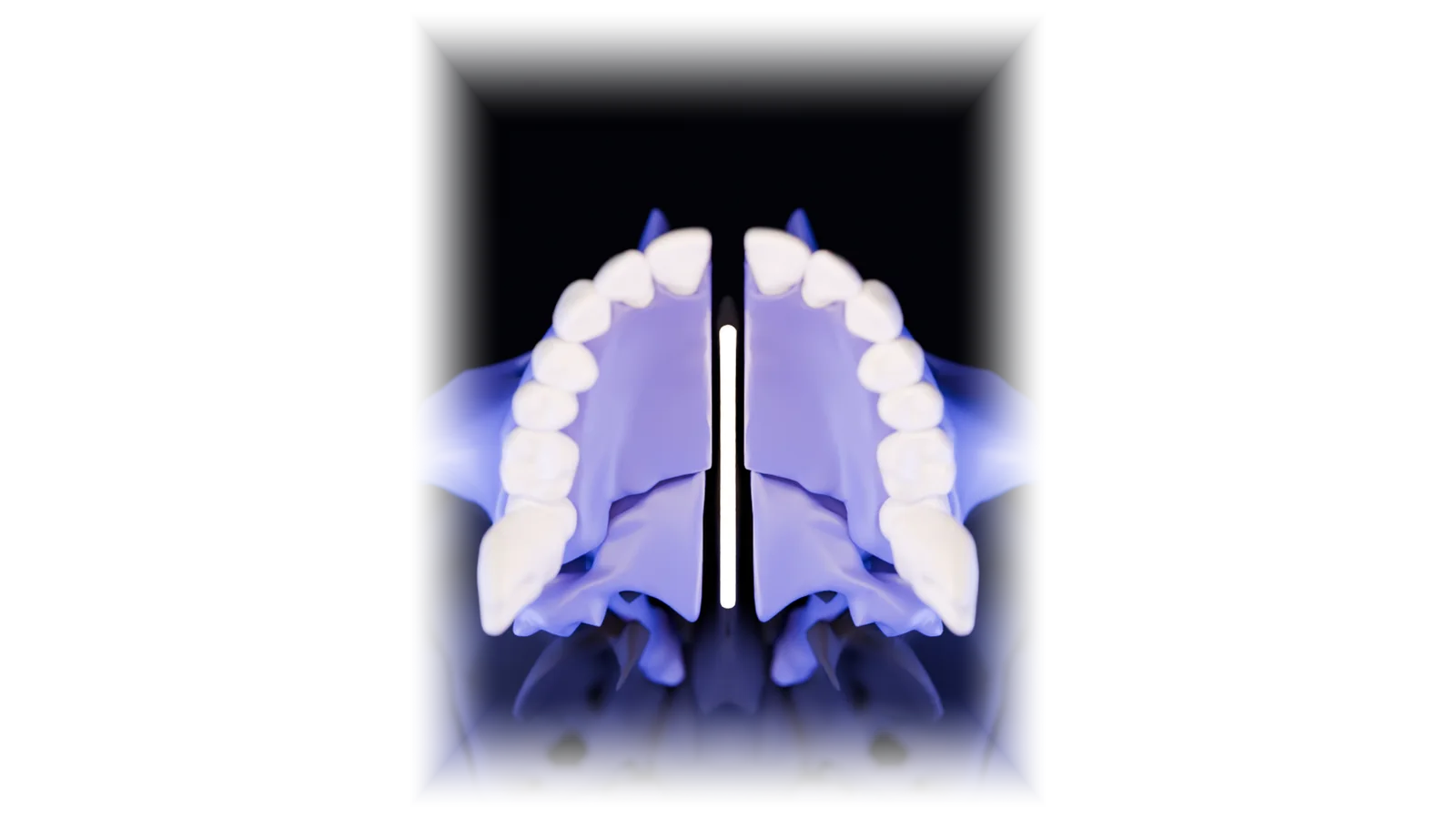
The palate seen from below, with the suture opening.
Palatal expansion: when the issue is width
Not everything is forward or back, up or down. Sometimes, the face needs width.
A narrow upper jaw
Not every imbalance in the face runs from front to back or from top to bottom: some are about width. When the upper jaw (maxilla) lacked transverse growth, that is, growth in width, the upper teeth may sit inside the lower ones when you bite (what's called a crossbite), look crowded, or leave dark spaces at the sides of the smile. Often, the palate also looks high and narrow.
Why it matters
The upper jaw is the base of the smile and also the floor of the nose. That's why its width influences how the teeth fit together, how the load is shared when you chew, how wide the smile is and, in some cases, it's evaluated together with breathing. A crossbite on just one side can also lead the lower jaw to shift to one side as you close. It's the same face, seen from another axis.
Options depending on timing
Giving the upper jaw back the growth in width it lacked is sometimes possible with orthodontics: expanders supported by the teeth or by mini-screws, or custom solutions, digitally designed in 3D for what your case needs. While the face is still growing, the central suture of the palate responds more easily. Other times, expansion needs to be assisted by surgery; today there are multiple techniques for this, less invasive than before. And when only a little width is missing, in some cases the upper jaw can be segmented—divided into parts—within the same orthognathic surgery, to restore a harmonious relationship. Each option has its place, and the choice depends on your case.
How it's decided
The 3D virtual study shows how much width is missing, where, and how mature the bone is; the clinical exam and what we talk about together complete the diagnosis. With that, orthodontics and surgery define the path together. When expansion comes first, a later orthognathic surgery, if needed, is safer and simpler; other times, width is addressed within the same surgery. Orthodontics plans your face from the position of the teeth; surgery, when involved, moves the structure. Today we can do things that used to be impossible; everything else we look at in your consultation.
If your bite crosses over or your smile looks narrow, in your evaluation we measure in 3D what your case needs.
Frequently asked questions
What is palatal expansion?
It means giving the upper jaw back the width it lacked as it grew, when it's narrower than the bite and the face need. Depending on the case, it's done with orthodontic expanders supported by the teeth or by mini-screws, with custom designs, or assisted by surgery. The goal is for the teeth to fit together and for the smile to have its natural width.
Can the palate be expanded once growth has finished?
Yes. Once craniofacial growth has stabilized, the palatal suture no longer opens as easily, but there are options: expanders supported by mini-screws, expansion assisted by surgery—today with less invasive techniques than before—or, if only a little width is missing, segmenting the upper jaw within orthognathic surgery. The choice depends on your case.
Why expand before orthognathic surgery?
Because giving the upper jaw its width back first makes orthognathic surgery, if needed, safer and simpler. When only a little is missing, in some cases the width is addressed within the same surgery, by segmenting the upper jaw. We decide together based on your diagnosis.
Is it normal for a gap to appear between the front teeth?
Yes. When the upper jaw widens, it's expected that a gap opens between the front teeth. It's temporary: orthodontics closes it afterwards. Your team will explain what each stage will look like, so nothing takes you by surprise.
What does expansion feel like?
The usual feeling is pressure in the palate and the nose on the days it's activated, which gradually eases. Your team will tell you how to manage it and, if needed, how to activate the appliance at home.
Does expansion improve breathing?
The upper jaw is also the floor of the nose; that's why, in some cases, expansion is evaluated together with breathing. It's not a general promise: it depends on the cause of each breathing difficulty and, when needed, it's evaluated as a team with an ENT (ear, nose and throat) specialist.
Do you know someone who should read this?
Share it on WhatsApp or Instagram. It's information to help understand, not a diagnosis.