Class II face: convex, long, short or bimaxillary retrusive
Often it isn't the teeth. It's the base that holds them.
What a Class II face is like
In a Class II face, the lower jaw sits back relative to the upper jaw. Many people come in saying "my teeth stick out", and sometimes that's true: the front teeth tip outward (Class II division 1). Other times they tip inward and end up hidden (division 2). Underneath, what defines this face is how the bones developed: in most cases, the lower jaw lacked development; other times, both jaws did, in all three dimensions.
There isn't just one Class II face. The most common are:
Convex: the profile curves outward in the middle and the chin sits back, with a small or poorly defined lower jaw that blends into the neck.
Long: on top of the lack of forward development, the face grew too much downward. We cover it in Long face.
Short: the face has little height, the upper teeth cover much of the lower ones and the fold under the lip is deep. We cover it in Short face.
Bimaxillary retrusive: both jaws lacked development, and the teeth may fit well. We cover it in Bimaxillary retrusive face.
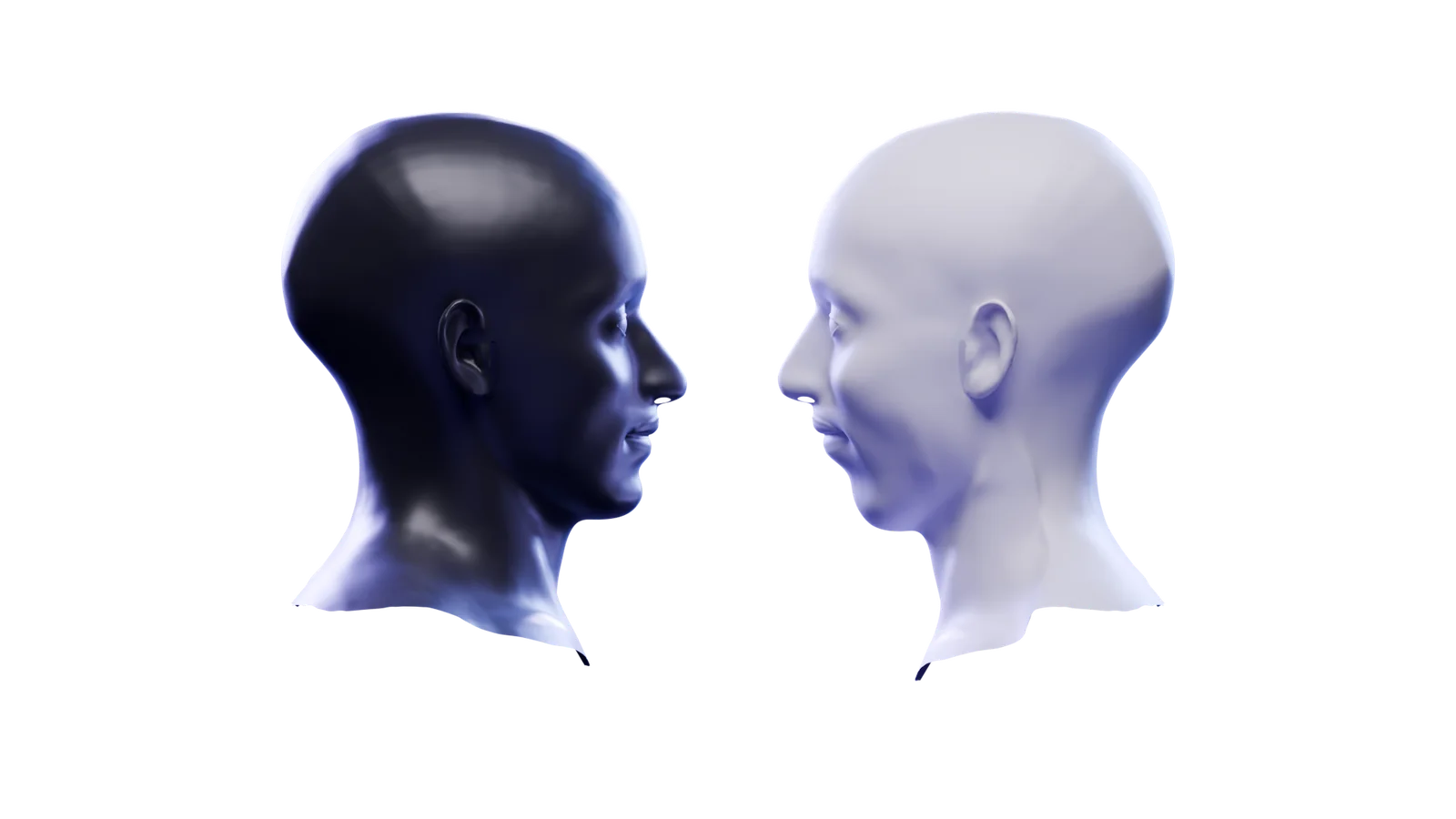
What you notice and what you feel
Aesthetic: a convex profile, a chin set back and a jawline with little definition. The front teeth look like they stick out or, the other way around, hidden, and they tend to crowd because there isn't enough room. The lower lip may get caught behind the upper teeth, and the face looks more childlike than expected. The nose can also look prominent without being the problem: when the lower jaw and the chin sit back, it stands out by contrast. What matters is the face in its overall harmony, not one isolated part.
Functional: when the lower jaw develops less, the tongue and the muscles attached to it have less room, and the space for breathing shrinks, especially during sleep: snoring, sleep that isn't restful, daytime sleepiness, waking up at night. Biting into food with the front teeth and closing the lips without effort can also be hard.
Oral: front teeth that stick out are more exposed to knocks and fractures. If the upper teeth cover the lower ones a lot, the lower teeth can mark the gums or the palate. The jaw joints are more prone to problems (TMD): pain, tiredness when chewing or keeping the mouth open for a while, noises and, sometimes, a jaw that locks or slips out of place.
Postural: to gain breathing room, the head tends to move forward and breathing often shifts to the mouth. The tongue rests low and, when the lips are brought together, the chin tenses and puckers.
How it's treated
There's no single formula. Each case is decided individually, based on what your diagnosis shows, what you prefer and what the team sees for your situation. Most often, the foundation is orthodontics and surgery working together: your teeth, and how they fit, are the key that makes everything come together and stay in place, and surgery brings the structure into an optimal, harmonious position. In a Class II face, that usually means bringing the lower jaw into place and, when the case calls for it, the upper jaw or the chin too. Depending on the case, other specialties or facial procedures are added. Everything is planned beforehand on a digital twin of your face; the full path is in The process.
If you recognize yourself in this, the first step is to look at the whole picture. At your evaluation, we study your face comprehensively and talk through your options.
Frequently asked questions
Is Class II the same as having protruding teeth?
Not always. In some cases the front teeth tip outward; in others, they tip inward and are barely noticeable. In both, the underlying issue is often that the lower jaw lacked development. That's why we study the whole face: how the jaws, teeth and joints relate to each other.
Can it be corrected with orthodontics alone?
In some cases, compensatory orthodontics is a valid alternative: it moves the teeth without moving the bone. It meets more limited goals and, in certain cases, has consequences that aren't ideal. At your consultation, we go over each option with you, with its advantages and its limits, so you can decide with clear information.
Is Class II related to snoring?
It can be. When the lower jaw lacked development, the tongue and the muscles attached to it have less room, and so does the airway, especially during sleep. Snoring or feeling tired when you wake up are signs to evaluate, not a diagnosis. If sleep apnea is suspected, it's confirmed with a sleep study (polysomnography) and other tests, and we work as a team when the case calls for it.
Why does my jaw hurt or lock?
In Class II, the jaw joints are more prone to problems: pain, tiredness when chewing and, sometimes, dislocations, when the jaw locks or slips out of place as you open. That's why the plan takes them into account from the start: so they're well prepared for surgery, end up in an optimal position and keep working well over time.
Does surgery always include the chin?
Not always. Often what needs development is the whole lower jaw, not just the chin, and bringing it into position is what gives the face definition. Other times the plan adds a genioplasty, or includes the upper jaw too, to achieve harmony and function. It's decided case by case, during virtual planning on the digital twin of your face.
Will my face change?
Your face will look harmonious, but you're still you. Surgery brings the structures of your face into an optimal position: your features are better supported and your profile comes into balance. During virtual planning, we review together where we're headed, before surgery.
When can surgery be done?
Surgery is done once craniofacial growth has stabilized, and that's evaluated case by case. There's no upper age limit: what defines the timing is your diagnosis and your preparation, not a date on the calendar.
Do you know someone who should read this?
Share it on WhatsApp or Instagram. It's information to help understand, not a diagnosis.